Thursday, March 30, 2017

Visualising 4 digit numbers by an 8 year old

Today was math class for 4 digit numbers. Introducing the place value and identifying 4 digit numbers was the plan.
the task was easy and Chaaru could follow based on the previous learning. Infact she picked up quite fast.

As per the design approach, we started discussing the relevance of 4 digit numbers in real life.
Where do you find 1000 to 2000 people together?
Chaaru: In India?
Me: the whole of India onlu 2000 people?
Chaaru: Coimbatore?
Me: hmmm
Chaaru: Vadavalli?
Me: Chaaru think and tell me, dont just say something.
(suddenly her eyes were swelling with tears)
Chaaru: I dont know. I cant nderstand.
Me: No problem (hugs and smiles). Lets try and understand. ok how many people will be living in our apartment...
thus begun the analysis and we computed the following:
52 houses - 4 people in a house - 52 + 52 + 52 + 52 =208 people. this is less than 1000

School where she studied:
1 class = 5 sections
1 section = 32 students
5 sections = 32 + 32 + 32 + 32 + 32 = 160 students
there are 12 classes = how many students?

""Amma should we count 160, 12 times :( "
Me: No, lets see if we can do it any other way. 12 can be written as 10 + 2 or 5 + 5 + 2

Chaaru: I can do this, (she added 160, 5 time and then 2 times)
SO 12 classes = 820 + 820 + 320 = 1960 students

In a School there are around 2000 people (and that was an achievement, you should see the happiness to believe it)

This was a very meaningful exercise where the child could visualize 4 digit number. Unless this understanding is initiated, the learning will be a mere calculation/technical mastery, without any relevance to her life.

The next step is to give different perspectives of 4 digit numbers, in terms of weight, distance, money, etc. Once the child is able to visualise the numerical context, application/operation of numbers will be more relevant.

Welcome home schooling :)

Tuesday, March 07, 2017

A Designer Math Teacher – My Approach


What is design?
Design conveys any intended message to people.
Art is a creative expression of an artist.
Unlike art, success of a design lies in, how easily it is understood by a common man. This is the reason designs are the most popular medium of communication.
A design encompasses different mediums, ideas, interactions, information, objects, books, posters, products, packaging, places, signs, systems, services, furniture, websites.

Every design involves a process, from research, conceptualizing, prototype, testing, implement and evaluate.

What is designing in math teaching?
Math is a language with its own vocabulary. We say, or we are aware of this… But never approach it that way.

Visualize the following classroom scenarios.

English class - Children we read the story of Rapunzel today.
I hope you all enjoyed it. Now let us try and understand the difficult words in this lesson.
1. Tower - a tall building from where you can see far off
2. Tangled - something which has lot of knots in it, ex. wire, rope or hair

Math class - Children we learnt two digit addition today.
So tell me what is 20 + 5? (30 the teacher corrects by adding/counting after twenty 5 more so 25) Very good. What is 12+12? (24) Excellent!.

Observe, in the English class, the focus is on understanding the vocabulary.
Where in the math class the focus is on understanding the technique.
Has any teacher asked, "children what is the meaning of the word addition?” The problem starts from here.

What we do not understand, we do not enjoy. This lack of understanding in math vocabulary keeps piling through the years of schooling. Eventually even after 12 years of education, we do not understand math.

Some of my friends (age 40+) comments on math
"Till today I do not know what a denominator means, except for it is written below the numerator"
"Guess what, tangent always went in a tangent. Could never place it in the right place"
"I always run in the opposite direction when someone takes the name of LCM and HCF, never can tell the difference..."

So is designing for math just explaining the vocabulary?
No. It is just a part

My approach to designer math learning
1. Explain the need with a bit of history. (If I do not feel the need for it, I am not going to be interested in it)
2. Conceptualize (can give perspectives, eg add is including, increasing, more than, etc)
3. Help the students visualize, it can be a story or an experience
4. Teach the technique and allow discussion on the same
5. Practice (not like 100 sums to drive you insane)
6. List the vocabulary and give meanings (this can get creative and funny)
7. Have a conclusion (mind map helps). It can also be a connection to the next concept.

All this need a truck load of creativity, patience and the luxury of time.
More successful in a 1-1 environment. (Will this improve score/marks? I do not know)

Welcome home schooling :)

Wednesday, June 01, 2016

Applications on Percentage - The Story of A T-Shirt

I am Swami and I have a retail outlet in the city. Now I am in the spinning mill to buy t-shirts on whole sale.
The wholesale price of a t-shirt is Rs.200. Now I have to decide on the retail price (MRP), which will be the cost price of the customer to buy a t-shirt. This should include my overheads like shop rent, electricity, maintenance and a profit margin.
I decide it to be 20%. So

the cost price CP = 200 + (20% OF 200)
            = 200 + (20/100 x 200)
            = 200 + 40
            = Rs.240
For any t-shirt, irrespective of the cost, I will have a margin of 20%.
So my profit on a single t-shirt will be
 SP - CP              = 240 - 200
  Profit                 = Rs.40

When I came back to my shop, I realised that there are few tshirts which were not sold from the last season (old stock). I cannot keep them and incur a loss. SO I decide to sell it for a discount of 15%.(CP being Rs.240). The Sale price of this tshirt will be
Sale Price      SP = CP - Discount
 = 240 - (15/100 x 240) 
 = 240 - 36
 = Rs.204

What will be my total profit for the day if I sold one new and one discounted t-shirt each?
Profit = CP - SP
       = (240 + 240) - (240 + 204)
       = 480 - 444
       = Rs.36
What percentage is this profit?
Profit % = Profit/CP x 100 (As both profit and loss are always calculated on the CP)
= (36/480) x 100
= 7.5%

This way I maintain a record of profit/loss on a daily basis and try to run my business, obviously for a profit.
What would you suggest should be my profit margin for (a) girls frock (b) boys denim and (c) party wear . WISH ME LUCK!!!

Tuesday, April 26, 2016

Algebra - INTRO STORY (1) - Bijaganitha

The seed counting - by Bhaskara The Teacher

Bhaskaracharya was a 12th century Mathematician, born in modern day Karnataka. He was one of the original thinkers who wrote on mathematics. A medieval inscription in an Indian temple reads:-
Triumphant is the illustrious Bhaskaracharya whose feats are revered by both the wise and the learned. A poet endowed with fame and religious merit, he is like the crest on a peacock.

Bhaskaracharya wrote the Siddhānta Śiromani (1150 AD), a treatise on mathematics when he was 36 years old. It is divided into 4 parts and can be considered as separate works. 


Imagine math written in a poetic language and named as "The Beautiful". Well, its the LilavatiThe name of the book comes from his daughter, Lilāvati. The book contains thirteen chapters, 278 verses, mainly arithmetic and measurement.
Bijaganita It is divided into six parts, contains 213 verses and is devoted to algebra. It was the first text to recognize that a positive number has two square roots (a positive and negative square root).
Ganitadhyaya and Goladhyaya are devoted to astronomy. All put together there are about 900 verses.(Ganitadhyaya has 451 and Goladhyaya has 501 verses).
Note: 12th century was a important period in the history of mathematics. It is the time when trade was flourishing with the East, and Eastern knowledge gradually began to spread to the West. Indian numerals were modified by Arab mathematicians to form the modern Hindu-Arabic numeral system (used universally in the modern world).

Thursday, April 21, 2016

Introduction to Algebra

Algebra is the Language of Mathematics

Algebra is one of the most important and interesting topics in middle school mathematics. Here children understand the use of unknowns, with practical application in their daily lives. Experience of understanding algebra at school goes a long way in the kind of liking/hatred one will develop as an adult towards mathematics. So it is very important for the teacher to first understand the concept and help students interpret the same.

There are 3 important things I should understand as a teacher when preparing to introduce algebra
1. Algebra is the generalization or abstraction of arithmetic.
2. It is clearly the pure language of mathematics, which requires knowledge of  the mathematical vocabulary (symbols and variables) and grammar (algebraic rules)
3. Algebra is a tool for mathematical modeling (solving real world problems)

The effective way to introduce algebra at middle school is by recollecting something students already know (interlinking subjects) or using an activity.

Algebra has been an inevitable part, in the growth of different civilizations. Following is a mind map of the respective contributions.

(The teacher might or might not elaborate on the different contributions. But can give it as group assignments to initiate research/ exploratory learning among the students)


(Click on the image to enlarge.)

Saturday, April 16, 2016

Suares, Cubes and their Roots - INTRO STORY (1)

Fibonacci and other number sequences

Consider this set of numbers 0, 1, 1, 2, 3, 5, 8, 13, 21, 34, 55, 89,..... how would you define this series?
If you observe carefully you can find that every number is the sum of its previous two numbers
0 + 1 = 1
1 + 1 = 2
2 + 1 =3
3 + 2 = 5 and so on. These are known as Fibonacci Numbers or the Fibonacci Sequence. This sequence is surprisingly found every where in nature like the spiral arrangement of pineapples, the seeds of a sunflower or the arrangement in a pine cone.

Who was this Fibonacci?
He was a 13th century Italian mathematician who wrote a hugely influential book called “Liber Abaci” ("Book of Calculation"), in which he promoted the use of the Hindu-Arabic numeral system, describing its many benefits for merchants and mathematicians alike over the clumsy system of Roman numerals then in use in Europe.

Before Fibonacci wrote his work, the sequence Fn had already been discussed by Indian   scholars, who had long been interested in rhythmic patterns that are formed from one-beat and two-beat notes. The number of such rhythms having n beats altogether is Fn+1; therefore both Gospala (before 1135) and Hemachandra (c. 1150) mentioned the numbers 1, 2, 3, 5, 8, 13, 21, … explicitly.

the Fibonacci or the Hemachandra numbers, there are other interesting patterns formed with numbers.

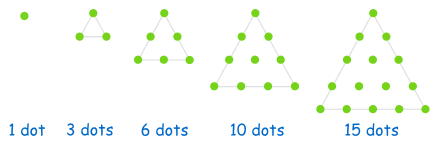
Triangular Numbers

Pattern - Add the next integer to the bottom and count the dots.

triangular numbers


Squares 

Pattern - add increasing odd numbers to get the next number or product of a number multiplied by itself.


Cubes 

Pattern - product of a number multiplied by itself 3 times.


Monday, April 11, 2016

EXPONENTS AND POWERS - INTRO STORY (2)

The Story of Googol and Googolplex

A googol is a large number equal to 10^(10^2)=10^(100) (i.e., a 1 with 100 zeros following it). 

Written out explicitly,
10000000000000000000000000000000000000000000000000000000000000000000000000000000000000000000000000000


Edward Kasner (April 2, 1878 – January 7, 1955) was a prominent American mathematician who was appointed Tutor on Mathematics in the Columbia University Mathematics Department.
In 1940, with James R. Newman, Kasner co-wrote a non-technical book surveying the field of mathematics, called Mathematics and the Imagination. It was in this book that the term "googol" was first introduced:

 If you start reading the book at the beginning, you'll come to the first chapter, titled "New Names For Old." Here is the relevant passage about the invention of the words "googol" and "googolplex":

"Words of wisdom are spoken by children at least as often as by scientists. The name 'googol' was invented by a child (Dr. Kasner's nine-year-old nephew) who was asked to think up a name for a very big number, namely, 1 with a hundred zeros after it. He was very certain this number was not infinite, and therefore equal certain that it had to have a name. At the same time he that he suggested 'googol' he gave a name for a still larger number: 'Googolplex.' A googolplex is much larger than a googol, but is still finite, as the inventor of the name was quick to point out. It was first suggested that a googolplex should be 1, followed by writing zeros until you got tired. This is a description of what would happen if one actually tried to write a googolplex, but different people get tired at different times and it would never do to have Carnera a better mathematician than Dr. Einstein, simply because he had more endurance. The googolplex then, is a specific finite number, with so many zeros after the 1 that the number of zeros is a googol. A googolplex is much bigger than a googol, much bigger even than a googol times a googol. A googol times a googol would be 1 with 200 zeros, whereas a googolplex is 1 with a googol of zeros. You will got some idea of the size of this very large but finite number from the fact that there would not be enough room to write it, if you went to the farthest star, touring all the nebulae and putting down more zeros every inch of the way."

--MATHEMATICS AND THE IMAGINATION, Kasner and Newman, page 23.

Lets us explore the concept of exponents...

Friday, April 08, 2016

EXPONENTS AND POWERS - INTRO STORY (1)

Exponential Growth and the Legend of Paal Paysam

Exponential Growth is an immensely powerful concept. To help us grasp it better let us use an ancient Indian chess legend as an example.


The legend goes that the tradition of serving Paal Paysam to visiting pilgrims started after a game of chess between the local king and the lord Krishna himself.
The king was a big chess enthusiast and had the habit of challenging wise visitors to a game of chess. One day a traveling sage was challenged by the king. To motivate his opponent the king offered any reward that the sage could name. The sage modestly asked just for a few grains of rice in the following manner: the king was to put a single grain of rice on the first chess square and double it on every consequent one.
Having lost the game and being a man of his word the king ordered a bag of rice to be brought to the chess board. Then he started placing rice grains according to the arrangement: 1 grain on the first square, 2 on the second, 4 on the third, 8 on the fourth and so on:

Following the exponential growth of the rice payment the king quickly realized that he was unable to fulfill his promise because on the twentieth square the king would have had to put 1,000,000 grains of rice. On the fortieth square the king would have had to put 1,000,000,000 grains of rice. And, finally on the sixty fourth square the king would have had to put more than 18,000,000,000,000,000,000 grains of rice which is equal to about 210 billion tons and is allegedly sufficient to cover the whole territory of India with a meter thick layer of rice. At ten grains of rice per square inch, the above amount requires rice fields covering twice the surface area of the Earth, oceans included.
It was at that point that the lord Krishna revealed his true identity to the king and told him that he doesn't have to pay the debt immediately but can do so over time. That is why to this day visiting pilgrims are still feasting on Paal Paysam and the king's debt to lord Krishna is still being repaid.

Source
http://www.singularitysymposium.com/exponential-growth.html


The simple, brute-force solution is to just manually double and add each step of the series:
T_{64} = 1 + 2 + 4 + \cdots + 9,223,372,036,854,775,808
where T_{64} is the total number of grains.
The series may be expressed using exponents:
T_{64} = 2^{0} + 2^{1} + 2^{2} + \cdots + 2^{63}

So lets explore the concept of exponents and powers

There is another version of this story in Islamic Literature  http://quatr.us/islam/literature/chesswheat.htm

Wednesday, April 06, 2016

RATIONAL NUMBERS - INTRO STORY (2)

What does the word "Rational" mean?

Well the dictionary says:
 /'in accordance with the principles of logic or reason; reasonable; of sound mind/'
and the translations are as follows Hindi  विवेकपूर्ण , Tamil பகுத்தறிவு.


Whenever I think of Rationality, this story of Birbal comes to my mind.

One day Akbar asked his courtiers if they could tell him the difference between truth and falsehood in three words or less.
The courtiers looked at one another in bewilderment. "What about you, Birbal?" asked the emperor. "I'm surprised that you too are silent." "I'm silent because I want to give others a chance to speak," said Birbal.

"Nobody else has the answer," said the emperor. "So go ahead and tell me what the difference between truth and falsehood is — in three words or less."

"Four fingers" said Birbal. "Four fingers?" asked the emperor, perplexed. 

"That's the difference between truth and falsehood, your Majesty," said Birbal. "That which you see with your own eyes is the truth. That which you have only heard about might not be true. More often than not, it's likely to be false."

"That is right," said Akbar. "But what did you mean by saying the difference is four fingers?'. "The distance between one's eyes and one's ears is the width of four fingers, Your Majesty," said Birbal, grinning.


rational number is a number that can be expressed as a fraction or ratio.  
The numerator and the denominator of the fraction are both integers.


An irrational number cannot be expressed as a fraction.

Tuesday, April 05, 2016

RATIONAL NUMBERS - INTRO STORY (1)

Carl Friedrich Gauss was the famous 17th century German Mathematician. 
His mathematical skills were clearly visible from a very young age. His elementary teacher Büttner, one day asked all his students to add numbers from one to hundred. this was to keep them engaged for some time. So the students started summing up the numbers,
 1 + 2 + 3 + 4 + ............... + 100
Within minutes Gauss was sitting idle. The teacher asked why he was not doing the sum, for which he replied he's already finished it! and the answer is 5050.
Wonder how he did that? Gauss observed that there is a pattern in these numbers, 
1 + 100 = 101
2 + 99   = 101
3 + 98   = 101
.
.
.
.
50 + 51   = 101
so there are 50 pairs of 101. i.e 50 x 101 = 5050. interesting isn't it? 

Now try this, 


Find the sum of integers from -10 to 10. what will be your approach?

Can you apply the same for adding consecutive fractions? what do you observe?

We are going to study more operations on fractions and integers combined together, called Rational Numbers (Q). Hope you remember the Number System and where Rational numbers fall!.


 A rational number is a number that can be expressed as a fraction p/q where p and q are integers and q!=0. A rational number p/q is said to have numerator p and denominator q. Here, the symbol Q derives from the German word Quotient, which can be translated as "ratio,"


Monday, April 04, 2016

A Story For a Topic in Math

It is wonderful to open your math class with a story. My children always appreciated the little tit bits of information along with the regular class. It helps even more when you have a math class just after the PT or lunch time. Am going to record here relevant stories and mind maps for every chapter for classes 8, 7 and 6 in that particular order.
Its also my firm belief that every math teacher and student should know about who discovered a concept or how it evolved - to - what you are learning about it - how it is applied today.
not very difficult for the middle school curriculum.

Saturday, October 10, 2015

Teacher is part of being a Mother....

I am writing after two years,for the feeling is so intense and its like
"I actually knew this all along, that school is just an extension of home and I am a mother first and till the end".

When I started out as a teacher, it was a profession. I had to deliver and measured my SUCCESS by the performance of my students.
Oh! but what a beautiful feeling it is to grow gracefully into a mother. For now when I enter the class,
I am so sensitive to each and every expression on those faces.
I know when they smile or just nod their head,
I am more concerned when I see a kid tired,
I am particular that they first relax after their PT period before they open their math books,
We should be comfortable as a group inside the class room and when all those facial muscles are relaxed, I know I can start. Its ok to loose few minutes.
I am particular that if the kid is not feeling up to it, he/she should put their head down and rest. You can always learn it when you are fine...

And guess what a reward I got, for the first time in my 5-6 years of teaching math this kid came and said "thank you mam, I really enjoyed today's class". Well obviously, we had revision worksheets done under the trees, in the park.

Learning :  When my kids are cared for, learning happens naturally!

Sunday, July 13, 2014

Number System - The Whole Picture

Presenting a whole picture before explaining the concepts helps children have a complete idea about what they learn.
Like any other classification (animal kingdom, plants etc.) numbers too have a system.


  • Zero with Natural numbers form WHOLE NUMBERS
  • Whole numbers with negative numbers form INTEGERS 
  • Integers with fractions form RATIONAL NUMBERS 
  • Rational numbers with irrational numbers form REAL NUMBERS 
  • Real numbers with imaginary numbers completes the NUMBER SYSTEM


When you understand this it becomes easy to build on concepts one after another. Else the concepts sland as isolated ideas, difficult for the child to comprehend and remember.

Monday, November 12, 2012

talking place value...

Consider this scenario, you are shopping in a supermarket and have a long list of items. You want to do a quick check of the approximate value... This is where your place value comes in real handy.how?
Let the cost of items be like,
rs.1034
rs 973
rs.450
rs.228
rs.1005
rs.824
rs.2000
the best and perhaps the easiest ways to add is by splitting them according to their place values.

thousands - 1000+1000+2000 = 4000
hundreds - 900+400+200+800 = 2300
tens - 70+50+20+20 = 160

total it up = 6460 (approximately)

the actual value being = 6514

The importance of place value is very much underplayed in to-days schools. Practical examples, used to explain the addition based on place value will help better understanding.
we are taught a mechanical way of addition which obscures the basic principle. Memorizing addition values of the single digit numbers and applying them with carry overs helps us only so much as doing a sum correctly. Of-course this is necessary, but try and do your checking by using place value. I am sure you will enjoy the process.

Thursday, October 18, 2012

oh so sweet... (typo)

For the love of numbers - D.R.Kaprekar (1)

Once upon a time (January 17, 1905 to be precise), there was born a boy named Kaprekar. He played with numbers like you and I would play solitaire in our pc. Maths was his entertainment. He went on to become a maths teacher and spread the joy and fun of playing with number to others. He was a maths teacher in the beautiful hill town called Devlali or Deolali (1929-1962). A number theory addict, he was invited in many colleges to talk about his unique methods.

He would say of himself:
A drunkard wants to go on drinking wine to remain in that pleasurable state. The same is the case with me in so far as numbers are concerned.
Well ofcourse, many Indian mathematicians laughed at his number theory ideas and called it trivial. After his retirement in 1962 he found it difficult to survive with his pension. He was forced to take maths and science tutions to make enough money.

International fame only came in 1975 when Martin Gardener wrote about Kaprekar and his numbers in his 'Mathematical Games' column in the March issue of Scientific American.

His discoveries in number theory include
Let us make him our hero by entertaining ourself with these fun methods...

Wednesday, October 17, 2012

Can you imagine...the integers? (student)

If numbers are just numbers and operations (+, -, x, /) just symbols, oh... then maths is really boring.
Well, actually numbers can be imagined as values which make sense. HOW????

I was walking up the stairs with my lil chaaru behind. I had climbed 5 steps and she was still in the first step. Mummy come and hold my hand, lets walk up together. So i came down 4 steps.
Which step am I in? 1st step right.
This is how we should start learning integers, where down, below, back, wrong , etc generally denote the negative value of a number.
The above incident can be numerically written as 5+(-4)=1.

In a snake and ladder game I was in the 15th block. I gained 3 steps in the ladder and fell down by 7 steps. Where am I now. 15+3=18, 18-7=11. Here I have to come down by a total of 7 steps.

Draw the number line in a chart or a paper and stick it next to your bed. Try different jumping actions in the line till you understand the working of negative and positive numbers. 

Whenever you work on the integers, visualise the number line (?), imagine it in your mind. The figure should be stuck in your mind. Remember that zero lies between the positive and negative numbers. Well, Iam sure you know that zero has no value, positive or negative.


There you got it!!!

Wednesday, July 04, 2007

The "CRAP" principle

A term very interestingly coined by the design course at http://www.colorado.edu/.

The following is my version of the CRAP principle, which can be used in both graphic and web designs.

Contrast contrast brings in visual int rest and focus to the design.contrast can be brought in through fonts, colors and dimensions.a focal point (CVI) can be brought in the design using contrast, which is very essential in guiding the user through the design.contrast should also be balanced. Else it can create chaos.

Repeat repetition is a major factor in UI design to bring in consistency.repetition of elements like font color, header size, layout structure etc., tell the user that they are in the same web site.repetition also goes a long way in brand identity, repeating a particular style, by way of graphics, bylines or quote create a brand recognition.

Align alignment brings in rhythm and grace to the design.print designs like news paper and magazines generally justify the content and have a column alignment web pages favour left alignment and majority have a single column structure.every element in a page should be connected and aligned w.r.t each other. never have elements standing alone.always align a image with captions or baseline text.

Proximity group related design units in close proximity, thereby separating different units of the design.a single unity structure without proper grouping, results in a boring layout.there should be enough white space between one group and the other. maintain consistency in spacing different groups.

Friday, June 22, 2007

UI Basics - Few gudelines


“A good designer knows the user and designs for the user”

The user interface is the aggregate of means by which people (the users) interact with a particular machine, device, computer program or other complex tool (the system). The user interface provides means of:
• Input, allowing the users to manipulate the system
• Output, allowing the system to produce the effects of the users' manipulation.

- Wikipedia encyclopedia

The following list is a compilation of some basic guidelines every designer will follow and some of my personal experiences.

Even before that, there is one point which I would emphasize -
It is not enough if a design is aesthetically pleasing it should also be technically flawless.

1. Know your user and understand their profile (requirement gathering, persona creation and other usability tools)
2. The client is not always the end user. If you feel a certain element is essential in terms of the user, let the client know about it.
3. Follow consistency in terms of placement, color, functionality etc.
4. Make visual cues clear.
E.g. if link text are underlined, do not underline submenus or titles. This will confuse the user.
5. Know how to attract attention. Animated gif or a promotional tool should be attractive at the same time be in sync with rest of the page.
6. Use css and html to give optimum results. Understanding of SEO basics and css2 go a long way in making a good website.
7. Provide Help to the user.
About boxes, help documents, tool tips, visual cues etc (feed back to say action is complete).
8. Visually define the context. Cancel and refresh buttons placed together in a form generally created confusion.
9. Give importance to typography. Defining correct font size for headers, sub-headers and other text help the user to a great extent.
10. Use proper metaphors when you design icons.
11. Use controls effectively. (Radio button, check box etc.)
12. User testing is an absolute essential.

This is not an exhaustive list. Comments and suggestions are welcome.

Workshop for Educators

The AD & BC of Classroom Management and Creative Learning

Education is the responsibility of Every Individual - My Belief   “ THE AD & BC OF CLASSROOM MANAGEMENT AND CREATIVE LEARNING” ...